How Waterproof Jackets Actually Work
Beyond the waterproof label: a closer look at layers, moisture and the questions that matter in the rain.
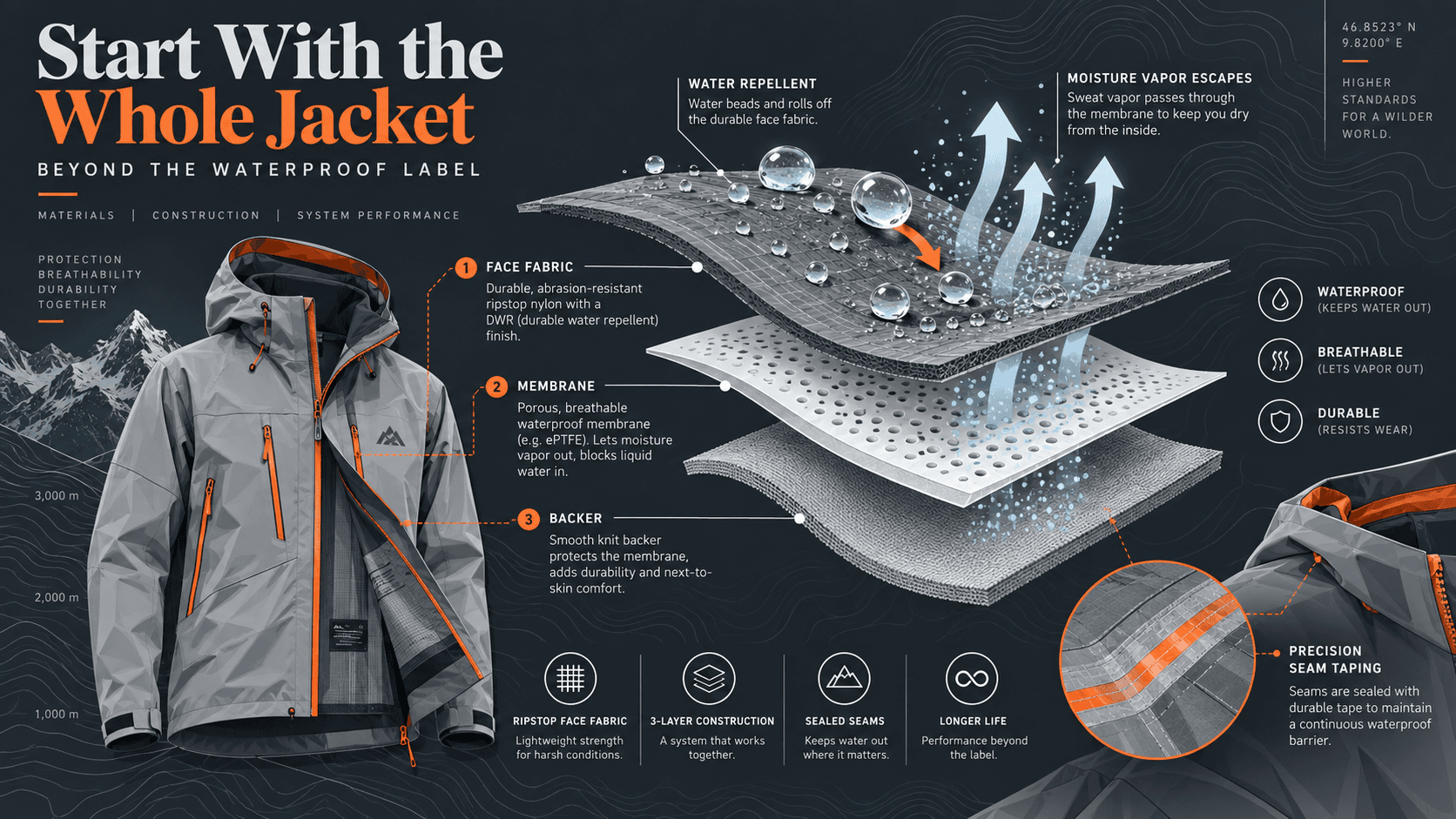
Start With the Whole Jacket: Beyond the Waterproof Label
Journal Entry 01 | Field Notes & Material Science
A "waterproof" claim on a hangtag is the beginning of a conversation, not the conclusion.
When you stand in front of a rack of technical shells, nearly every jacket claims total storm protection. Yet on an exposed ridgeline in the pouring sleet, two jackets carrying identical marketing labels can perform worlds apart. One keeps you dry and moving efficiently; the other leaves you clammy, chilled, and soaked from the inside out within forty-five minutes of a steep ascent.
The useful question on the mountain is never simply, “Is this jacket waterproof?”
The real question is: “What does that claim actually tell me about this specific garment, in these specific conditions, over time?”
To understand how a technical shell functions in the real world, you cannot look at a single specification in isolation. You have to evaluate the garment as a complete, unified system across three distinct layers of engineering.
The Three Layers of Questions
| Engineering layer | What it covers |
|---|---|
| Outer surface: face fabric & DWR | Abrasion resistance, water beading, breathability gate |
| Protective engine: membrane & laminate | Hydrostatic barrier, moisture vapour transport (ePTFE/PU) |
| Finished garment: patterning & construction | Taped seams, pocket geometry, hood articulation, zips |
1. The Outer Surface: The Face Fabric & DWR
The outermost textile does not keep water out on its own. Its job is to protect the delicate waterproof barrier beneath it and serve as the physical shield against sharp rock, pack straps, and tree branches.
Denier and Weave: Look past the brand name to the denier rating (e.g., 20D vs. 80D). A 20-denier face fabric offers featherlight packability for emergency weather protection, but sustained friction from heavy backpack hip belts will abrade it quickly. An 80-denier high-tenacity nylon face can handle abrasive granite and dense brush, but adds stiffness and weight.
The DWR (Durable Water Repellent): This microscopic surface treatment forces liquid water to bead up into droplets and roll off. When DWR fails or gets coated in dirt, the face fabric becomes saturated, a condition known as "wetting out." The jacket hasn't leaked, but moisture vapour generated by your body can no longer escape through the waterlogged textile. You end up soaked in your own perspiration.
2. The Protective Engine: Membrane & Laminate Architecture
Beneath the face fabric lies the functional barrier, typically an expanded polytetrafluoroethylene (ePTFE) or polyurethane (PU) membrane, engineered as a 2.5-layer or 3-layer laminate.
2.5-Layer vs. 3-Layer: A 2.5-layer shell utilizes a painted-on inner print to save weight, making it compact but prone to feeling clammy next to bare skin. A true 3-layer laminate sandwiches the membrane between the rugged outer face and an integrated inner backer (like a circular knit or micro-grid). This backer protects the membrane from skin oils, slides smoothly over fleece or wool midlayers, and actively wicks sweat away from your body.
Testing Methods Matter: A hydrostatic head rating (e.g., 20,000 mm) simply measures how much water pressure a pristine, brand-new swatch of fabric can withstand in a laboratory cup before droplets penetrate. It does not measure how that membrane handles flex fatigue, sub-zero cold, prolonged backpack abrasion, or contamination from body salts.
3. The Finished Garment: Patterning, Seams, and Ventilation
A laboratory-tested membrane is useless if water bypasses it through garment construction flaws.
Seam Construction: Every needle puncture creates a potential leak. Modern technical design minimizes seam counts entirely, places seams away from the tops of shoulders where backpack straps press, and seals them with narrow micro-tape (e.g., 8mm to 13mm). Narrow tape reduces weight and preserves the breathable surface area of the jacket.
Zippers & Flaps: Highly water-resistant, urethane-coated zippers eliminate the weight and bulk of traditional snap flaps, but require precision installation and garages to prevent dripping at closure points.
Ergonomics & Patterning: Does the hem lift and expose your lower back when you raise your arms to reach a handhold? Does the hood rotate cleanly with your head when cinched over a helmet, or does it leave you staring at the inside of your collar? True performance is defined by kinematic cut and functional mobility.
Technical Breakdown: A Framework for Reading the Spec Sheet
Before taking performance figures at face value, use this systematic framework to evaluate what a manufacturer's spec sheet reveals and what it leaves out:
| Evaluation Stage | What to Look For | Why It Matters on the Mountain |
|---|---|---|
| What was measured? | The exact property and standardized metric (e.g., Hydrostatic Head in mm, RET, or MVTR in g/m²/24h). | Differentiates quantifiable physical performance from trademarked marketing slogans. |
| How was it tested? | The specific test standard (e.g., ISO 811, JIS L 1092, or ASTM E96). | Test results vary wildly depending on temperature, humidity, and pressure conditions during the test. |
| What does it apply to? | Whether the number reflects the raw membrane, the 3-layer laminate sandwich, or the assembled jacket. | A membrane rated at high breathability drops in real-world performance once laminated behind a heavy 80D face fabric. |
| What is still unknown? | Durability data, contaminate resistance, long-term seam tape adhesion, and mechanical stretch limits. | Laboratory ratings reflect day one out of the factory, not year three on the trail. |
What to Ask Before Your Next Objective
Before packing a shell into your backcountry kit, run through this four-point checklist:
What is the primary objective and climate?
Are you dealing with prolonged coastal downpours where a bombproof 3-layer GORE-TEX Pro shell is mandatory, or high-output ski touring where air permeability and massive underarm pit zips take priority over absolute static waterproofing?
What does the care protocol demand?
Do you know how to clean this specific garment? Dirt and body oils break down seam adhesives over time. If a jacket cannot handle regular laundering and tumble drying to heat-reactivate its DWR, its lifespan drops significantly.
How does the articulation interact with your complete layering kit?
A shell shouldn't fit like a tailored suit. Does it leave sufficient volume for a lofted down or synthetic midlayer without compressing the insulation and causing cold spots across your shoulders?
Can the performance claims be verified?
Are the features solving genuine mountain problems (such as harness-accessible pockets and glove-friendly cord locks), or are they aesthetic details added for everyday street appeal?